Click on any of the main images for a larger view

28 March 2013

Barn Owl documentary, RTE1, next Tuesday

Colin, with a Barn Owl chick, during filming in June of last year, at a Duhallow nest site.

Here's one for the diary – Tuesday 2nd April 2013, on RTE 1 television at 7pm – Wildlife documentary maker, Colin Stafford-Johnson, hosts a half hour long documentary on Barn Owls. Most of the filming was carried out in Duhallow and Kerry in summer 2012. The team followed John Lusby, Michael O'Clery and Brin McDonald as they carried out research and fieldwork during the Duhallow Raptor Conservation Project, and features some amazing footage of Barn Owl nests at two derelict cottages in Kerry and a tree nest in a family's back garden in Cork.

The crew filming John Lusby at a nest site in Co. Kerry. The chicks were down the chimney of the derelict cottage.

21 March 2013

Duhallow Report, 2012 now available

The Duhallow Raptor Conservation Project Report, 2012 is now available for free to download. It shows the results from last years project on Raptors in Duhallow, including all the fieldwork, nest box and publicity aspects to the work, many of which you will have seen illustrated on this blog.

Some of the highlights are:

A survey of suitable buildings for Barn Owls highlighted a site availability of 14.6 suitable buildings per 100km2 (range: 8 – 26), and located seven nest sites and 13 roost sites.

A density of 2.6 breeding pairs of Barn Owl per 100km2 was recorded, which is higher than similar findings elsewhere in the country. 

An innovative playback and acoustic survey was also employed for Long-eared Owl for the first time in Ireland. A total of 6 breeding sites and 7 active territories were confirmed, representing a minimum density of 4.3 Long-eared Owl territories per 100km2.

A breeding success of 66.6% was recorded at six known breeding attempts for Long-eared Owl with an average brood size of 2.25 young per brood. 

There were 22 Barn Owl nest boxes in place in Duhallow by the end of 2012, representing one of the highest densities of boxes in the country. 

Ten Kestrel nest boxes were installed at suitable sites which marked one of the first formal nest box schemes for this species.

An awareness campaign promoted  the 2012 project and its objectives, and the work was publicised through posters (136), and a wide range of events and presentations (12), articles in newspapers and magazines (9), and features on websites (2). This blog, www.duhallow.blogspot.com, was also set up to make the project accessible to the general public, and received over 13,000 page views from over 20 countries by December 2012.

To view the lower resolution PDF, see it on this page HERE.
To download the full report, go to this page HERE. (Opens a new window, on www.box.com, where you can view and download the higher resolution file. File size is 17Mb).

8 March 2013

Snapshot of the 2012 season


The findings from our fieldwork in Duhallow in 2012 is available to read online, or download (see the post below).

A quick summary of the findings...

15 Barn Owl nest boxes were in place for the 2012 breeding season. Four of these were used as roosts, two as nests. (a 40% uptake).

13 sites were recorded as active during survey work in 2011 and nine of these were still active in 2012. Four were abandoned.

12 new Barn Owl nest sites and 14 roosts were discovered in Duhallow during fieldwork in 2012 – a total of 35 active sites. 20 were nests.

Of the 20 nests, the most common sites were derelict farm houses (9), trees (4), castles (2), farm buildings (2) and one each in a modern unoccupied dwelling, an occupied dwelling and a ruined creamery.

The most common nest site type was roof spaces (7), chimneys (6), cavities in trees (4), nest boxes (2) and one in a water tank.

13 (65% of) nests produced young, lower than the national average.

Of 12 sites monitored, the average number of chicks per nest was 2.16, similar to the national average.

The nest box scheme and particularly the Survey highlight Duhallow to be of national significance for the Barn Owl population, holding one of the highest densities per surface area recorded in Ireland. 

The results of the monitoring work also showed the vulnerability of the local population and the necessity for continued and strategic monitoring as well as further implementation of effective conservation measures to help maintain the status of the Barn Owl in Duhallow. 

Download the full version, below.

Download the Duhallow Barn Owl Report, 2012

The findings of the 2012 Duhallow Raptor Conservation Project 2012 are now available. Download and read the PDF of 'The ecology and conservation of the Barn Owl in Duhallow – Duhallow Barn Owl Project. 2012, Final Report.'
You can view it on the page here, or hit the 'Download' button below to download it to your hard drive. It's only 350Kb and 17 pages.
-

6 March 2013

Owls for egrets

Part of the Duhallow Raptor Conservation Project involves installing ten Long-eared Owl nest baskets into suitable trees in Duhallow. These mimic the crows nests (usually Hooded Crow) in which the owls usually nest, and preliminary trials in Galway have already proved successful. However, the same techniques have just been used in Co. Kerry, in an experiment to see if Little Egrets might also take to the nest baskets. 

An ordinary metal garden hanging basket was used, and branches and twigs were interwoven to create a shallow, saucer-shaped nest. This is about the size of a normal Little Egret nest.

Three baskets were then placed high in an area of conifers overlooking an estuary. The site has been chosen as not only is it in a private garden (and is thus relatively secure), but has had up to ten Little Egrets roosting in these very trees over the past two winters. While Little Egrets would normally build their own nest, they won't be able to avoid seeing these three ready-made nest baskets, and hopefully they will decide that this is, after all, a perfect place to nest. Let the experiment begin...

25 February 2013

Sure signs of Kestrels


Kestrels will often roost in modern barns and ruined buildings, as well as trees and on cliffs, spending the night perched high on a beam or other sheltered perch or ledge. Modern barns are often used, and during our Kestrel Survey, we examine any suitable (preferably little-used or disused) farm building, like this one above in Co. Kerry, to look for signs of their presence...

...and here it is... 

The photo shows an area of 'whitewash' on the ground, the distinctive 'chalky' droppings of birds of prey, below a high perch in the disused barn. And scattered around, the small, distinctive pellets which Kestrels regurgitate a few times a day. When broken open, they contain the indigestible remains of their prey, mostly fur and bones from mice and shrews, and often beetle wing cases. A nest box placed in this barn has a very good chance of being seen by the local Kestrels, and hopefully they will take to nesting in it this summer.

18 February 2013

Stopping the Jackdaws

At some sites in Ireland, Jackdaws can be a real problem when placing nest boxes for Barn Owls. They also nest in cavities, and once they find one they like, will line it with sticks until the size of the cavity is to their liking. They are such industrious stick collectors that they will quickly fill a large nest box cavity until there is just room for their nest and little more. This renders it useless to Barn Owls. Thankfully this has only happened at one of our sites so far, and if Barn Owls move in, only the most foolhardy of Jackdaws would go near it (see an example of this on this page HERE.


Although we normally recommend the type of nest box shown on this page HERE, there are one or two sites where a specially adapted box can be used to thwart Jackdaws. The double entrance on this box means the Jackdaws have trouble manoeuvring large sticks around the corners and into the main chamber, and the high second entrance also means that if the Jackdaws put sticks into the first, smaller chamber, the second will not be blocked. It seems to work!


This box was placed high in the rafters of a derelict school in Co. Kerry, last week. The design should deter any interested Jackdaws, and the outer covering of tarpaper will help keep out the elements in this rather exposed site. The rest is up to the Barn Owls...

(Photos: M.O'Clery).

15 February 2013

A helping hand


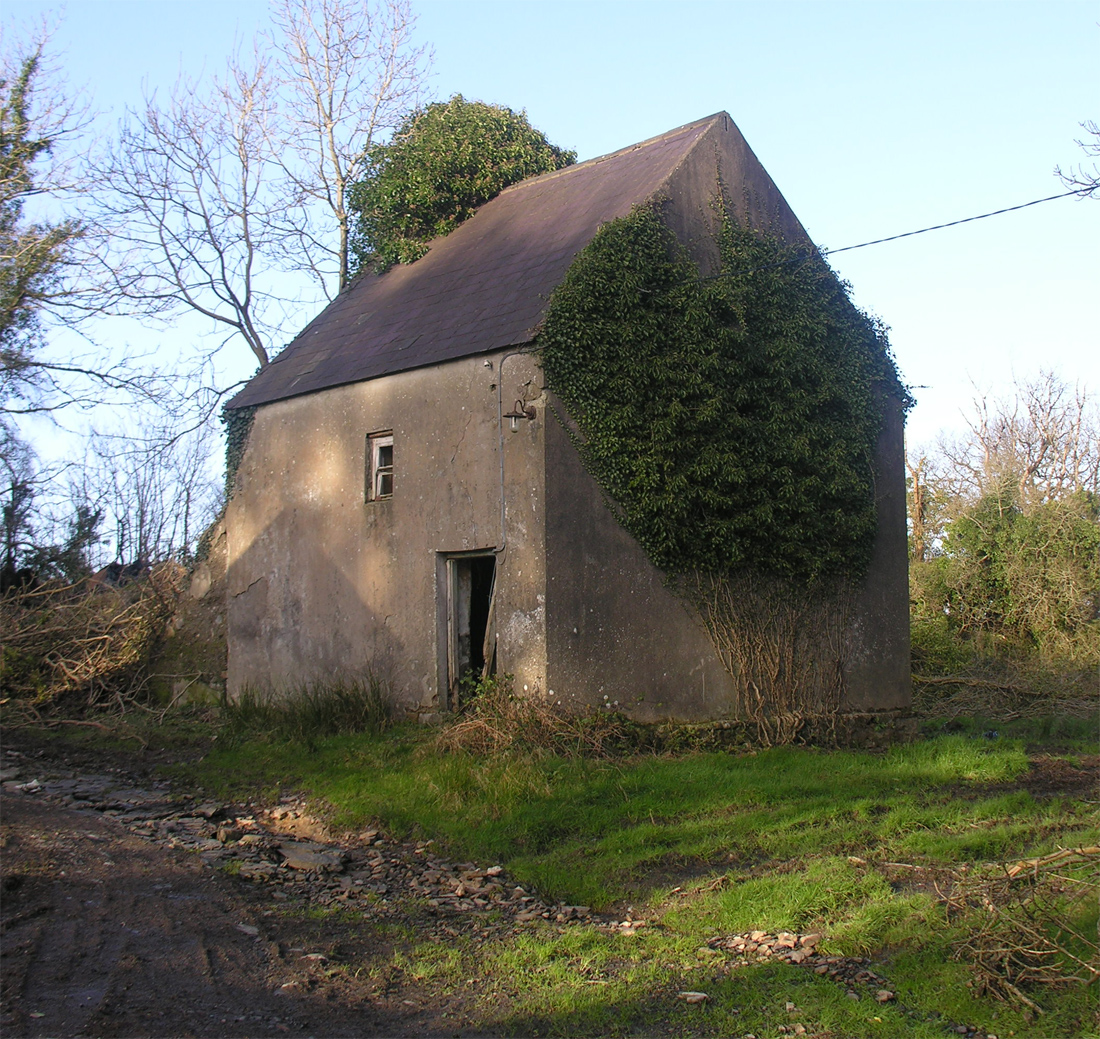
Landowners and farmers are vital to the success of the Duhallow Project, and without exception, we have received nothing but friendliness and cooperation during our work. Joe, pictured below, not only allowed us to place a Barn Owl box in one of his barns last week, but showed us to two other ideal sites, such as the derelict house above (Photos: M.O'Clery).

12 February 2013

Getting ready

Spring is on it's way, and we are gearing up for the 2013 breeding season. There is still time for putting up nest boxes, and five more Barn Owl boxes were installed during the week.


Disused barn in Duhallow, now containing a Barn Owl nest box (Photos: M.O'Clery).

Two boxes were placed in Kerry and three in cork, and they were installed in disused barns (including the one pictured above), an old piggery shed and a derelict house.

14 December 2012

One final Barn Owl nest found 2012

Thanks to an interested member of the public contacting us, one more Barn Owl nest has been located in Duhallow, perhaps the last for 2012. The birds have nested successfully in the chimney of an abandoned cottage for at least the last three summers. This brings the total number of known Barn Owl sites in Duhallow to 36, of which 21 are nests and 15 are active roost sites. This represents one of the highest densities of Barn Owls in the country. 

Barn Owl nest, in the central chimney, Duhallow (M.O'Clery).

51 out of 113 nest sites nationally are in chimneys and 33 out of the 113 are in derelict farm houses/cottages, so this nest site is about as typical a Barn Owl nest site as they come, though this summer there were a series of less typical sites used for nesting, such as an old water tank, tree cavities and an unfinished new building.