Click on any of the main images for a larger view

9 August 2012

How long before a nest box is used?

Despite the poor breeding season in 2012, one of the great positives during the project has been the uptake of a nest boxes by Barn Owls. A box put in place in a barn in Duhallow last November produced two young, and we have a female now resident in another which was only installed in early 2012. Another bird has been sighted at a third box.

As the Project heads toward autumn, thoughts are turning to where to place the next series of boxes, and we have already chosen a number of suitable sites. Five more boxes will be in place within the next two months, ready for any prospecting Barn Owls.


Careful siting of a nest box can greatly increase the chances of it being used. This one is in an old hay barn in Co. Kerry. A bird has been visiting it in each of the two previous winters. Will it pair up and breed there next summer? – let's hope so (M.O'Clery).

From our experience throughout Kerry and Duhallow, nest boxes might be taken up at any time after their installation. At one site, where the original nest was found to be suddenly unsuitable (slates had blown off from over the nest, allowing rain to fall directly into it), we placed a nest box close by, and the birds moved in within about five weeks and raised two young that summer. In two cases this summer, boxes which had been in place for over three years were finally used as nests by the owls. One of these had no owl activity around it for the three years, the other had birds occasionally visiting the site in winter and spring, but disappearing each summer.


Brin McDonald from the Duhallow Raptor Conservation Project holds one of two chicks which hatched from a Duhallow nest box this summer. Brin and John Lusby installed the box last winter. (M.O'Clery).

So if you are planning to instal a Barn Owl nest box on your farm or premises, there are a few important points to bear in mind, which you can read about on this page HERE.

Good luck, and remember, it can be a few years before the owls move in.

3 August 2012

Barn Owls make the news


News presenter Seán Mac an tSíthigh interviewing John Lusby at a Barn Owl site in Co. Kerry on Tuesday (Photo: M.O'Clery).

Short news features on Barn Owls featured both on RTE 1 main evening News and TG4 news programmes over the past two days. They were filmed in Co. Kerry over the past few weeks with the main clips filmed on Tuesday last.


The TG4 clip was aired on 1st August and can be seen on this website page HERE.
Search for "NUACHT TG4 - Episode:213"


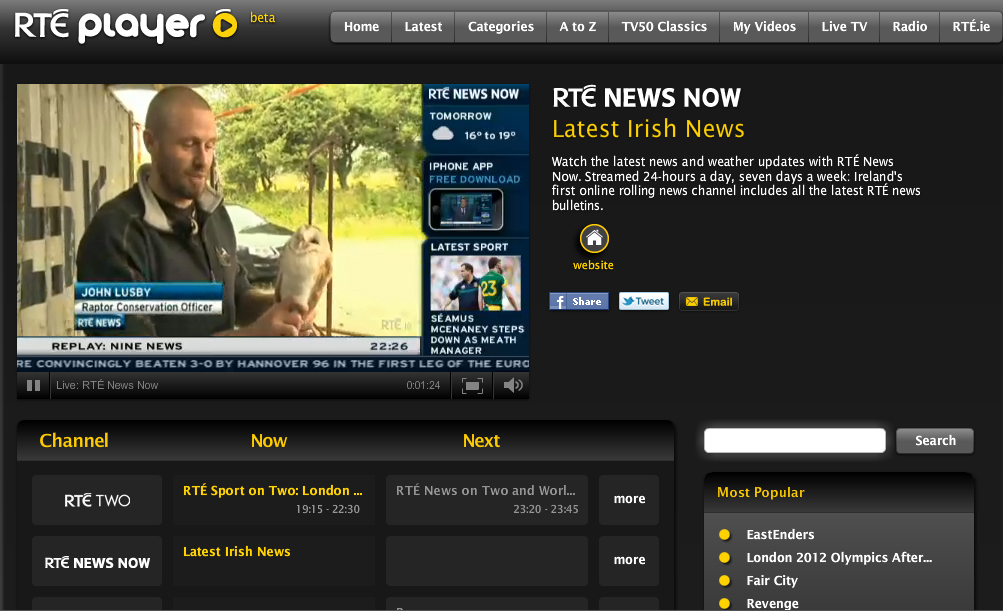
The RTE clip was shown on the RTE1 main 9 O'Clock news today, 2nd August, and can be seen on RTE Player on this website page HERE (available until 10th August 2012). Search for "9pm NEWS 2nd August".

2 August 2012

What moult can tell us

We've seen in an earlier post (HERE) how the moulted feathers of adult birds at a nest site indicated that they had failed to breed this year. Another post (HERE) showed how we were able to age a one year old female. 

In this case, a known nest was visited in Co. Kerry two weeks ago where, unfortunately, no breeding had taken place in the nest box this summer. However, after checking the roost site in a blocked chimney in the same room of an old barn, this beautiful male was caught and ringed.


Male Barn Owl, Co. Kerry, mid-July (M.O'Clery).


The extended left wing of the same bird (M.O'Clery).


The left wing showing the numbered primary feathers (M.O'Clery).

Barn Owls have 11 primary flight feathers on each wing. Number 11 is tiny and is usually hidden under feathers near the leading edge of the wing. Primary number 10 is the first main flight feather, primary 9 the second and so on. In this photo, we can clearly see that primary 6 is just starting to grow. The original primary 6 would have dropped out, initiating the growth of a new one at the base of the wing. These primaries are replaced one by one so that at no point is the owl's ability to fly and hunt impaired.

Barn Owls leave the nest with a full set of fresh feathers, which they retain for a full year. After that, the wing feathers are replaced one by one, a few weeks apart, for the rest of their lives, so this bird is in his third year. Most Barn Owls don't survive in the wild more than 3 or 4 years, so this one can be regarded as something of a veteran. Let's hope he survives the winter and gets to breed again next year.

29 July 2012

Final phase of Long-eared Owl survey

The fourth and final phase of the 2012 Duhallow Long-eared Owl Survey will begin on 1st August.

The first phase in April was the tape-playback of the calls of adult Long-eared Owls, and all responses from adult birds were recorded in three 10 km squares in Duhallow (each 10 km square equals 100 square kilometres). This phase resulted in 6-7, 3 and 3-4 territories being located in each of the squares. However, not all Long-eared Owls will respond to the tape, so three follow-up visits were planned, in May-June, in July, and again in August.


Long-eared Owl chick (Photo: Eric Dempsey).

Since then, with two full re-surveys of the three squares, some additional territories were located by listening for young Long-eared Owls calling at night (you can hear what they sound like on this page HERE). The final phase which is about to start will be a final re-survey of the three squares in the hope of locating any late-nesting Long-eared Owls. Although most Long-eared Owls will have already finished breeding this year, and the young fledged and dispersed, there are still reports coming in from around the country of Long-eared Owl chicks calling, as recently as Friday last, so it is possible that one or two more may be found in the Duhallow squares.

Either way, it looks as though Long-eared Owls outnumber Barn Owls by about two to one in the three 10 km squares.

26 July 2012

More Duhallow Barn Owls ringed

Two more Barn Owl chicks have been ringed at a site in Duhallow which we saw in a slightly earlier post below ('Can NAMA help Barn Owls?').

There were three chicks in total, but it seemed that two had already fledged and moved out several days ago, though as it transpired, the two were roosting at the back of the house. When John Lusby visited the nest site on Tuesday, he was able to capture, weigh, measure and ring two of them, before returning them to the nest site.


Barn Owl chicks, Duhallow, 24th July 2012 (F.O'Sullivan. Chicks ringed under licence from NPWS).

Three is a very good brood size this year, with only a few other sites producing three chicks. Most have seen just 2, while several more nests have failed completely. The one positive aspect of the poor breeding summer for the owls is that at least none of our Duhallow sites have been completely abandoned. At all the failed sites, one or both the adults are still present. Should next spring and summer be even a little better than this one, there is every chance they will breed again.

25 July 2012

Barn Owl nest camera goes live

Ireland's first Barn Owl web cam went live this afternoon.


Screengrab from the Mooney Barn Owl Nest Camera. The adult male delivers a Bank Vole to the two chicks.

The camera can be accessed through the Derek Mooney page on the RTE website HERE. Click on the Barn Owl image on that page to see live footage of the owls, which are in a Co. Kerry nest box.

24 July 2012

John Lusby on Mooney radio show today


John Lusby, with Barn Owl, June 2012 (Photo: M.O'Clery).

Tune in to Derek Mooney's radio show today (Wednesday 24th July), from 3pm on RTE1, for an interview with John Lusby about Barn Owls. John is the Raptor Officer for BirdWatch Ireland, and is the leading expert on this species in Ireland.

Young Barn Owls disperse

The young owls, in the post below, seem to already have dispersed, just days after the discovery of the nest in an unfinished, new-build house. The chicks were almost adult-like on 19th July and by 23rd seemed to have already vacated the nest site, though one was now using the adult's roost site. Below, perhaps the last view of a chick at this nest this year. 


Barn Owl chick, Duhallow, 22nd July 2012 (Photos: F.O'Sullivan).

Where might this fledgling end up? Most will disperse to within 10 to 50 kilometres of their birthplace, but some might go further, and in theory, this young bird could turn up anywhere in Ireland. Barn Owls can breed at one year of age, but most will die before reaching that stage. Any number of possible threats await them, from collision with cars and overhead wires, to poisoning and starvation. It's a tough life out there, and only the hardiest (or luckiest) few will survive to breed next spring. Let's hope this one finds a good territory of his or her own and makes it through those difficult first months.

19 July 2012

Could NAMA help Barn Owls?

Why on earth have we posted a photo of the gable end of an unfinished house? 


Is this one of the many unfinished 'NAMA estates' or apartments that litter the Irish countryside after the property bubble burst so spectacularly? Well, this particular house in Duhallow has a slightly different history and remained incomplete following the untimely death of its owner about 2 years ago, but in the meantime, some unexpected tenants have moved in... 
Click on the photos for a closer look.


Adult Barn Owl, Duhallow, 18th July 2012 (Photo: F.O'Sullivan).

The Barn Owl in the photo is one of the adults of a pair which nested in the building this summer. The photo shows one at the roost site entrance yesterday morning at 6.00am. The nest entrance was on the opposite side of the same gable, in a similar hole, and contained at least 2 well-developed young, probably around 50-55 days old. They should be ready to take their first flight any day now, and we hope to ring the nestlings soon, before they depart.

While surveying for Barn Owls, there is of course a need to search disused and derelict buildings and ruins, but this is the first time a nest has been discovered in Ireland in a new, unfinished, building. Could there be other Barn Owl nests in some of the many houses and estates that lie idle throughout Ireland? We will obviously have to look harder at these types of building in the future.

17 July 2012

Screeching fledglings

The three chicks ringed at a tree site in Duhallow two weeks ago (see the post HERE) are doing well, despite the atrocious weather. A check on them a few nights ago at dusk saw all three flying competently around the nest site, and two eventually moved away into the trees, still snoring for food from their parents. One, perhaps the youngest, stayed close to the nest, calling frequently. Have a listen to the video. It's nearly dark, so the video can't pick up the birds in the foliage, but the snoring calls are distinct, and have developed into an occasional full-blooded screech. 


Three Barn Owl chicks near their nest, now at the flying stage, and no doubt soon ready to leave the area to find their own territories (Filmed under licence: M.O'Clery).

All three fledglings could leave the nest area at any time now. The dispersal of young Barn Owls generally occurs two to four weeks after they are able to fly, occasionally longer, but it could be in any direction. Who knows where they might end up once they leave? Many ringed birds have been re-found just 10-20 km from their birthplace, but others have crossed the country.